Showing posts with label Physics. Show all posts

Monday, January 16, 2023

Conquering the Dilemma of Explaining Surface Drifters and Clustering Algorithms in Less Than 4 Minutes!

 Sheryar Choudhry, Verrazzano Class of 2022, completed majors in Mathematics and Physics 
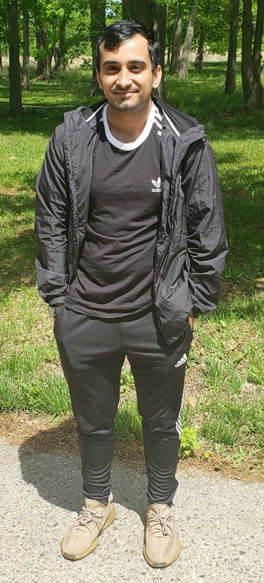

My capstone project is on clustering algorithms and their applications on surface drifters in the ocean. The data used in my research was collected in 2016 by CARTHE in their LASER experiment in the Gulf of Mexico. The goal was to release hundreds of surface drifters and track their positions over time.

In my research, we consider 185 of these drifters over the time span of 10 days. Out of the 185 drifters considered, which are on average 6km away from each other, 106 of these drifters end up in a clump that averages 70m across. A natural approach to studying this event is to cluster the drifters over the time period and study the clusters as they evolve into that clump.

When I started my project, I was already in the middle of doing this as my research, so turning it into my capstone project was a no-brainer. I had spent a lot of time with the data and I had plenty to talk about — but this soon became a problem. I wasn’t sure what to focus on and present. It seemed like all of it was important. It didn’t help that I wasn’t able to use any of the nice animations I had spent so much time on. Also, it didn’t help that I had 4 slides and a handful of minutes to explain what I did. It all seemed overwhelming. In the end, I decided to remove the portion of my research where I use the clustering algorithms to perform some analysis of the data. Therefore, adding that back would be a natural extension to my capstone project. Also, if I had more time, I would have also explored other clustering algorithms, such as k-means, and how they differ from my approach.

The hardest part of the whole capstone project was trying to present all the information in a way that someone with no prior knowledge could understand. Unlike a paper, I can’t assume people have some knowledge of the subject or use citations to avoid explaining everything. Throughout the process, I ended up changing the order of my slides many times as I realized the best way to present the research. However, I didn’t waste all of my precious slide space on definitions. Since there would be time for questions, I had some room to make assumptions.

Overall, it was a fun experience for me and I learned a lot from my mistakes. Perhaps in another timeline, we would have done the conference in person and I could have had my laptop on loop playing my fancy animations while I use all the time I’d like to explain my work. However, the constraints that were put in place make sense with all the people presenting and it does trim off any unnecessary fluff. Even with the freedom of the poster, I needed to choose my words carefully and be concise with my presentation.

I think this skill is invaluable. Especially today, where most people have become masters of talking, but not saying anything of substance. Hopefully, I am able to challenge myself and continue to grow on my journey to become a great scientist.


Monday, February 3, 2020

Summer Research at University of Oxford for Physics Major

Gaia Fabi, Verrazano Class of 2019, completed major in Physics 

Last summer, I was one of the seven European students who were chosen for an Astrophysics research project at the University of Oxford. Although I was a little hesitant at first to spend the summer in yet another academic environment which I had never experienced before, I am really glad decided to work there. As soon as I arrived in Oxford, I immediately loved the place. I felt at home. Since we all shared the same dormitories, I had the chance to meet and get to know my colleagues who would work with me in the Astrophysics Department. Except for one American girl, the others were from Europe and we all felt bonded by our common cultural roots and professional interests and goals. 

When I arrived at the University on my first day of work, I fell in love with the campus. I almost felt like I was part of a Harry Potter film setting! I met my mentor, Prof. Leah Morabito, who introduced me to her colleagues and to the project on Radio Astronomy which I was going to work on during the summer. The project consisted on testing the theory which would unify different types of Active Galactic Nuclei (AGNs) as a single class, predicting that they are not physically different but they appear to be different because we observe them from different viewing angles. AGNs are very interesting objects, since they are believed to be a result of accretion of matter by a supermassive black hole at the center of its host galaxy. 

For my analysis, I looked at the projected linear sizes of a selected sample of radio sources from the Lofar Two-Metre Sky Survey. This survey is provided by the Low Frequency Array (LOFAR), which is a powerful radio telescope in the Netherlands. I found my project fascinating and I was extremely engaged with it. Thanks to this research project, I was able to give my own contribution to a better understanding of the physics behind such powerful object in our universe, that is AGNs. 

Although the working hours were quite demanding – I worked from 9 a.m. to 5 p.m. from Monday to Friday – after work and on weekends I would meet with my fellow interns and we would have a lot of fun going to museums, movie theaters, pubs, and even punting. Furthermore, I had the opportunity to meet the astronomer Jocelyn Bell, the scientist who discovered pulsars and one the pioneers in engaging women in the STEM field. 

I feel that overall this experience has turned out to be a good preview of my future career and it has given me the chance to appreciate working in Europe. Through my project, I have learned some important research skills such as problem solving and critical thinking. I have also found out some things about myself and the tough skin I will need in order to stay in the area of astrophysics and pursue a PhD in this field. I can firmly state that working at Oxford has been one of the best experiences I have ever had.